
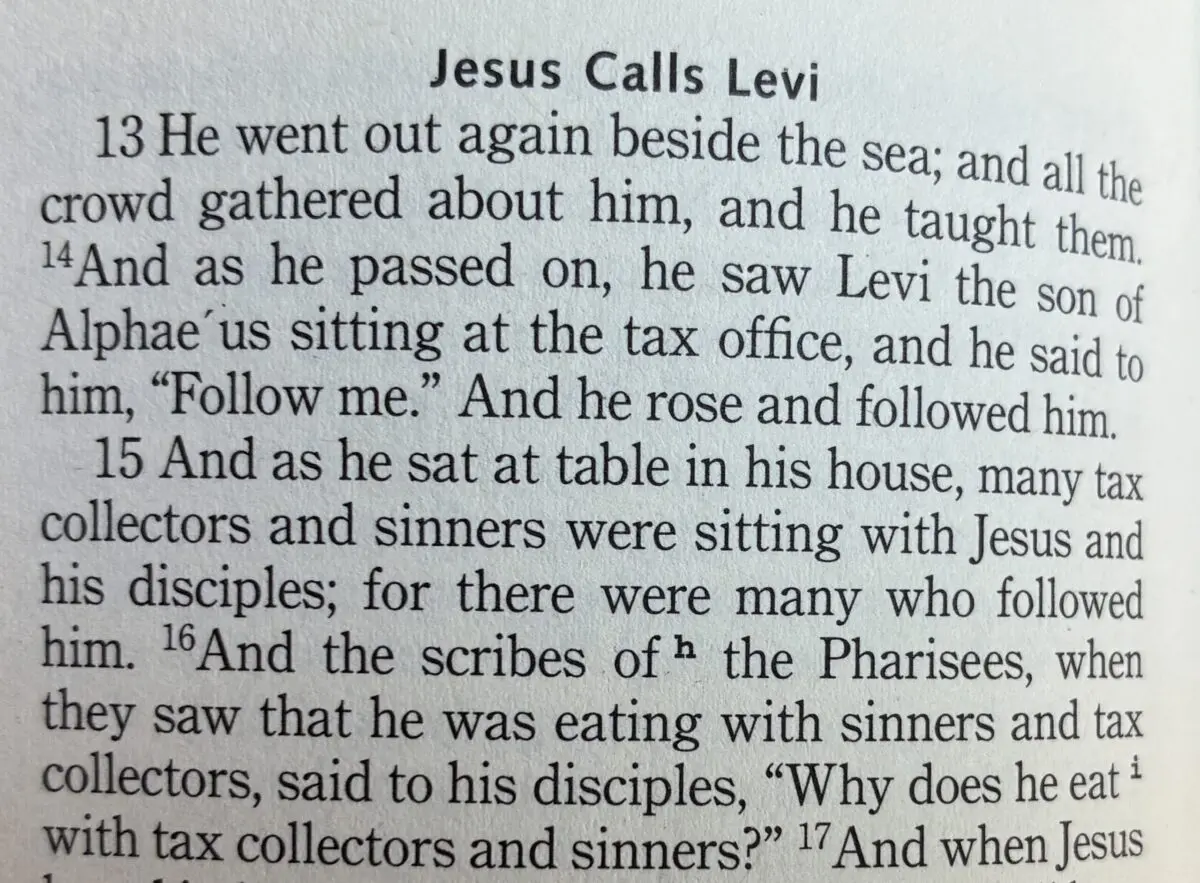
Reading through the Gospel of Mark for Lent, a priest led me to enter more deeply into the scene in which Jesus calls Levi (Mark 2:13-17). The priest encouraged his listeners to not only think from the perspective of being one of the sinners Jesus dined with, but also to think of what it was like to be one of the Pharisees.
“And the scribes of the Pharisees, when they saw that he was eating with sinners and tax collectors, said to the disciples, “Why does he eat with tax collectors and sinners?””
Coming from our modern-day perspective, having enjoyed over two thousand years of Christian teaching on mercy to the sinners and knowing that Jesus was God, the Pharisees seem like they’re being a little judgmental. But what if they were just confused? What if their question was actually very reasonable?
Prior to the coming of the Messiah, God had to prepare his people’s hearts for it. The descendants of Abraham and Isaac and Jacob were a people set apart, which was the original meaning of the word holy. God wanted them to keep themselves separate from the Gentiles and, more importantly, the sins of the Gentiles.
Because of the very hardness of heart God was trying to train out of his people, the Kingdom of Israel split in two after the death of King Solomon. The Southern Kingdom was made up of the tribes of Judah and Benjamin (called Judah and whose members were called Jews). The Northern Kingdom was constituted of the remaining ten tribes and kept the name Israel.
The Northern Kingdom was conquered by the Assyrians who dispersed the population of Israelites all over its vast empire and moved its own non-Israelites in to interbreed with the remaining Israelites. This was done in order to water down the bloodline and demoralize the Israelite population so that it wouldn’t become a problem for Assyria by trying to win back its independence. The conquered Northern Kingdom became the lost tribes of Israel and the mixed peoples became the Samaritans.
A little while later, Judah was conquered by the Babylonians who destroyed Solomon’s temple and marched the Jews off into exile.
With the northern tribes dispersed, the people of Judah in captivity in Babylon and the temple laying in ruins, the main way faithful Jews set themselves apart from the gentiles was by strictly following the dietary laws.
After about 70 years in captivity, the Jews were allowed to return to Jerusalem by the Persians (who had conquered the Babylonians) and had just started to get themselves together when they were conquered by the Greeks. They had a respectful vassal relationship under the rule of Alexander the Great, but then he died. They eventually fell into the hands of Antioch Epiphanes a Hellenistic king who was described simply as a “contemptible person” in Daniel 11. And boy was that an understatement!
Antiochus Epiphanes wanted to encourage unity throughout the area he ruled so he decided to make everyone be Greek-i-fied, or Hellenized, as it was called. And he did not take no for an answer.
He desecrated the rebuilt Jewish temple, insisted the Jews give up their worship of the one true God and worship pagan gods, destroyed and made it illegal to read the Torah and insisted that the Jews eat foods that were unclean to them. The Jews that refused to Hellenize were tortured and killed. For instance, those that circumcised their sons were killed and the babies were hung from their mothers’ necks. As stated previously, calling Antioch Epiphanes a “contemptible person” was a bit of an understatement.
The Jews responded in several different ways. Some Hellenized. Some refused Hellenization and accepted martyrdom. Some resisted and fought back. The resistance group, under the leadership of Judas Maccabeus, became known as the Maccabees and, against incredible odds, were able to win back Jerusalem and the Temple. And it started with them refusing to eat unclean food.
After more war waged and more territory won back, the Jews became comfortable in their power again and they split into two factions. Those that wanted to Hellenize and play footsies with worldly powers were called the Sadducess. Those that wanted to keep themselves separate from worldliness and zealously observe the Torah became the Pharisees. The two ended up fighting and the new power in town, Rome, stepped in and settled the dispute by taking over Jerusalem.
The Pharisees continued to try to keep themselves separate from the Gentiles –as God had instructed them through the law and the prophets for thousands of years– by zealously obeying the law. Though, some of them did start to go a bit overboard about it, perhaps we could give the rest of them some grace. By the time Jesus showed up, it had been 400 years since God had sent any prophets to elucidate the Jews on how they should be acting. And up until then, it seemed as though God really wanted them to keep themselves separate from unclean people and foods.
It is through this lens that one can understand why the Pharisee would ask, “Why does he eat with tax collectors and sinners?”
What Jesus was doing was actually mind boggling for them. He was a respected teacher, healer and an all-around holy man and he was doing this thing that God had told the people of Israel not to do for thousands of years. It would make one curious.
And I think that since their question was out of innocent curiosity, Jesus did not rebuke them as he did when Pharisees were being judgmental poops. Instead, he answered them, saying, “Those who are well have no need of a physician, but those who are sick; I came not to call the righteous, but sinners.”
What he said was revolutionary at that time. In fact, so much of what he was saying and doing was mind blowing back then, we just don’t realize it because we’ve been marinating in His teachings for over 2000 years. They are built into our society and culture. So it is with much irony that we sit on our high horse of 20/20 hindsight, look back and judge the Pharisees for being judgmental.


0 Comments