
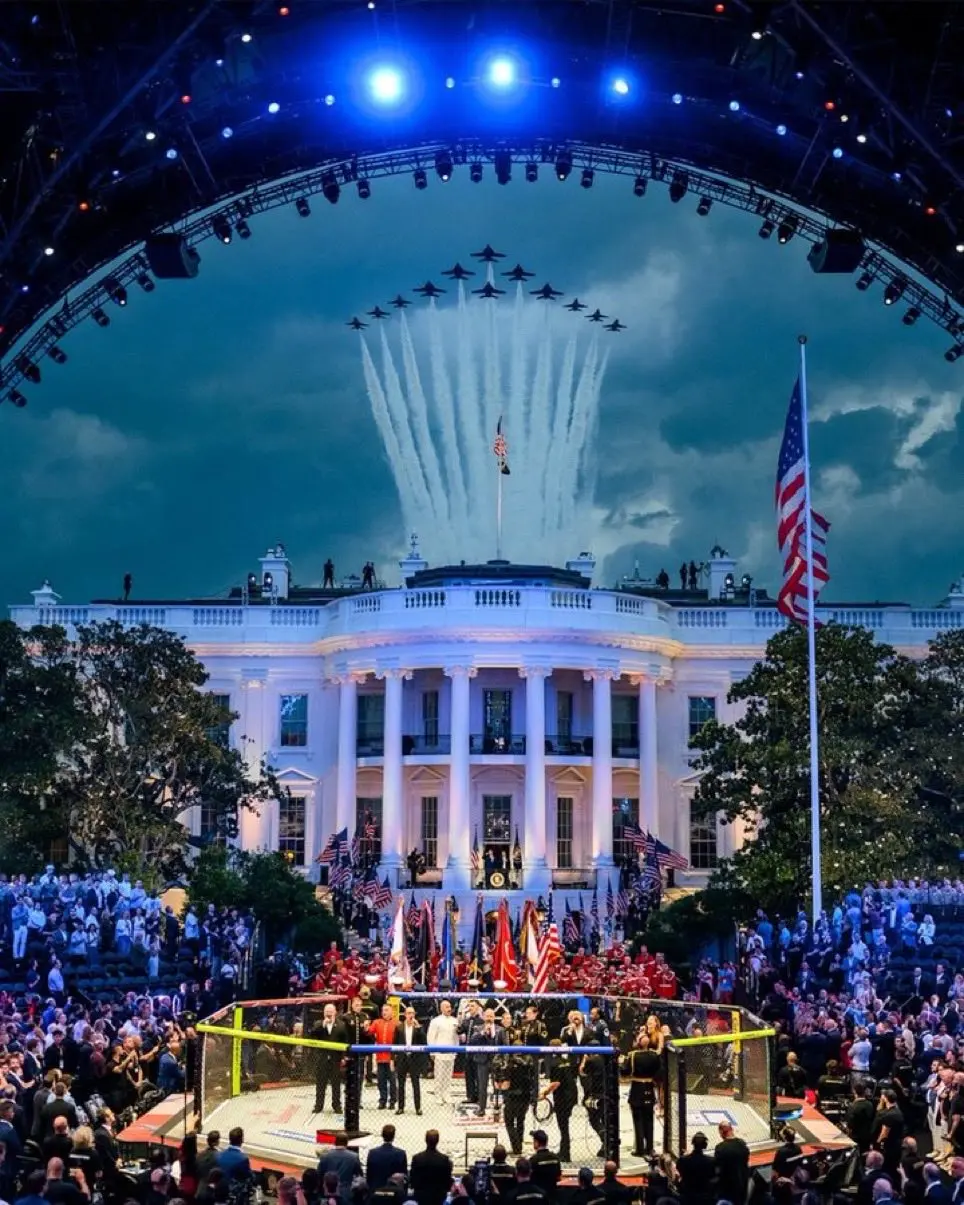
How did I find myself here? It’s after midnight –well past my 9 o’clock bedtime– and I’m standing, incredulously screaming at a man on the television to stay down as another man is punching his face into hamburger.
Introduction to First Fight
That was me watching the main event of the UFC Freedom 250. It was only the second fight card I’d watched. (I had to look up what fight card meant. It means the series of fights at an event).
I didn’t really grow up around anyone that was into combat sports. As the UFC started to gain in popularity, I heard the fights could be pretty brutal and my active imagination went wild over the horrors that could mean. Ipso facto, I kind of imagined myself into being too scared to watch one. Also, a priest I respect gave a pretty good case against watching people fight each other for sport. So, in addition to being a little trepidatious, I was also a little unsure of the morality of watching UFC fights.
At the beginning of this year, I saw it announced on X that Gina Carano would fight against Rhonda Rousey. I liked Gina Carano as an actress and personality and knew that she’d been a pioneer in women’s MMA. My curiosity was more than a little piqued to see her return to her roots and fight after a 17-year hiatus. What would that look like? How cool would that be if she won against all the odds against her? Especially since her last fight –and only MMA loss– was questionable in that her opponent was suspected of having steroidal help.
And that was the first fight card I ever watched. It was not a UFC fight, but a start-up competitor. And the fighting was not as brutal as I had feared, with the exception of one fighter who was described by a poster on X as “a crime scene” on account of the fact that he was covered in his own blood from a cut on his face. But really, it was just a lot of blood and he seemed fine other than looking like Sissy Spacek in the final scene of Carrie. The main thing I took from the event was age could be a major factor in the outcome. Several of the fights had an age gap and the guys close to or over 40 all lost (including Carano). I also learned that if someone gets you into an arm bar –a submission move which involves grabbing someone’s arm and bending it backwards at the elbow until that someone taps to let the referee know they give up (hopefully before serious damage is done)– that can quickly end the fight. Rousey beat Carano in 17 seconds with an arm bar.
Growing Up With All Girls and a Little History of the UFC
In fact, as a family, we enjoyed the fights and floated the idea of maybe, possibly watching another one. The UFC Freedom 250 provided us with a rather obvious opportunity.
Why did I enjoy the fights? I’m a fairly civilized, conflict-averse person who came of age during the era of the metrosexual man. It seemed like watching two men beat the bejezzus out of each other should be the farthest thing from enjoyable entertainment that I could find. And yet, I’m rather fond of watching the fights and I think it’s because they’re more than two men pounding each other in the face for money. They are, in reality, a study in masculinity.
I grew up in a family of all girls. Thereby, maleness and masculinity have always been a bit mysterious for me. Luckily, I convinced a man to marry me and through his tutoring and also my having several male children, I’ve managed to learn a lot about these inexplicable creatures. However, there never seems to be an end to the complexity of these individuals with XY chromosomes. I’m always discovering new facets of them that absolutely fascinate and perplex me. Men fighting each other for sport and their behavior in each match is completely absorbing for me because it is, in many ways, so foreign.
The UFC has, itself, lived the American dream. It started in 1993 as an open experiment to establish which martial art was the best in an actual combat situation. They would pit the karate guy against the Tai Kwon Do guy or the Sumo Wrestler against the kickboxer. Brazilian Jiu Jitsu rose to the top, but pretty quickly, the fighters started taking whatever worked from each discipline in order to win. That morphed into Mixed Martial Arts (MMA), which is what is commonly used in the UFC today.
In 2001, the struggling UFC was purchased by the Fertittas brothers and Dana White. Unfortunately, the original owners had stripped the organization down to practically nothing so the Fertittas and Dana White had spent two million dollars basically on 3 letters and an old wooden, eight-sided cage.
The sport was considered too violent (like human cock fighting, one person described) and nobody would host the fights. Donald Trump, a huge fight fan, stepped in and offered one of his venues to host fights. Now the organization had the crucial lifeline it needed to get going. It was from those days the friendship of Donald Trump and Dana White started, grew, and out of which fruited the gift to America of masculinity, heroism and unfettered patriotism in the form of the UFC 250 on the White house lawn.
The First Fight Moment of Note
A bad storm heading towards Washington D.C. threatened the event taking place outdoors. Luckily, Jesus knew how important this fight event was for the morale (soul?) of America, so he parted the storm in two and it passed harmlessly to the north and south while leaving the weather on the White House lawn perfect.
There were 7 fights on the main card, but there were particular moments in a couple of them that stood out to me as a curious observer from the fairer sex.
In the Heavyweight bout, Josh Hokit took on Derrick Lewis. Josh Hokit, 28, was 13 years younger than Derrick Lewis who was 41! Why would Lewis do this fight with the age deck so stacked against him? He had a career with an 83% knockout rate. Maybe he was hoping to get in there and just punch Hokit’s lights out (which also seemed to be the hope of the crowd who was obviously on the side of Lewis). Whatever his thinking, I thought he put up a pretty impressive fight. Hokit’s strategy seemed to be to exhaust Lewis and though Lewis looked completely, totally and utterly exhausted, he just wouldn’t give up. Watching him, I was getting second hand exhaustion, but he just kept going. At the end of the first round, Hokit got Lewis into an arm bar. Oh no! I feared this was the end for Derrick Lewis as it had been for Gina Carrano! But he powered through and endured it for the last 30 seconds until the bell rang.
They went into Round 2 and fought another 4 minutes before Lewis was knocked out by Hokit. It doesn’t sound long, but each of those minutes looked like they felt like a day to Lewis and yet he kept going.
It was such a triumph over resignation. Derrick Lewis went into that fight coming off a defeat, much older and facing an undefeated opponent and he still fought it like he had a chance. A masculine trait that sent the 300 Spartans into the impossible Battle of Thermopylae. They fought valiantly despite certain defeat. And though they came home on their shields, it was after having lasted long enough in battle to save Western Civilization.
The Second Fight Moment of Note
The Bantamweight fight between American Sean O’Malley and Canadian Aimann Zahabi brought up the tensions of late between Canada and America. Sean O’Malley manifested a victory by knocking out Zahabi in the second round, saluting the crowd of soldiers and bringing about a delighted roar from the audience. One X commenter posted, “O’Malley sacrificed a Canadian for the president!” A funny joke, but one that hearkened back to an old reality –when warriors brought back the head of the enemy to their kings.
The Third Fight Moment of Note
The next heavy weight bout was between Alex Pereira and Ciryl Gane. Their ages were similar (38 and 40), but in this fight, Pereira was moving up into heavyweight. Moving up a weight division is difficult, I read, and you could partially see why just in the differences of their musculature. Gane was larger, muscle-wise. Pereira was knocked out in the second round, but I was impressed by his wanting to take on larger opponents rather than just beating opponents that were more naturally his size. A masculine trait that was within King David when he went up against the Philistine giant.
The Main Event
The main event was between the undefeated Spaniard Ilia Topuria and the more battle tested and older American, Justin Gaethje.
Fate could not have set up a better underdog story. The odds were against Gaethje winning 6 to 1. He was 8 years older, technically not as efficient a fighter and on the down slope of his fighting career.
Topuria was on a 17-fight win streak, a technically superior fighter and was widely considered the best fighter in the UFC.
Gaethje versus his foreign adversary paralleled the birth of our country: an underdog nation against a superior foreign fighting force. Some think that if Polymarket had existed back then, the odds against the American colonies would have been 6 to 1 as well.
So, it was fitting that Gaethje, wrapped in an American flag, began his walkout from the Oval Office looking at the Declaration of Independence. He made his walkout to the song “Ain’t No Grave,” an anthem for himself, yes, but also for our country, which has survived so many unsurvivable moments.
On the battlefield, America met the Red Coats. In the Octagon, Gaethje met “Il Matador” who had already eaten his victory dinner the day before and had assured Gaethje he’d put him to sleep within two minutes of the fight.
“But he did not put him to sleep within two minutes of the fight,” said the narrator. What unfolded was the war Gaethje had said he expected when asked about Topuria’s fight length prediction. “I do not go in there with those expectations,” Gaethje said. “I expect a 25-minute war, and I expect to have to dig deep and to have to overcome a lot of adversity, and I’m ready to do that.”
As soon as the fight started, Gaethje hit Topuria with a punch to the right eye that set the tone. Gaethje wasn’t going down in two minutes. If Topuria wanted his 18th win, he was going to have to work hard for it. Looking at Topuria’s bruised face after the first round, my husband said, “That’s the look of a man who has just realized this is not what he thought it was going to be.”
Topuria did much better in the second round with many shots to Gaethje’s liver and almost had him bested. However, Gaethje held on and impossibly endured the beating, with the help of the crowd chanting their support, “USA! USA! USA! USA!”
Gaethje, having rallied, went into round 3 in a flurry of punches. Topuria looked fatigued and got battered, especially his face. He ended the round with both eyes so swollen that the doctor almost called the fight. Topuria insisted he was fine, which was news to everyone who could see his face. It looked like raw hamburger. “Justin Gaethje changes people’s faces,” Sean O’Malley later commented. The decision was made to let Topuria continue to fight.
Round 4 began and the pain was obvious every time Gaethje even brushed against Topuria’s face, but Topuria kept fighting. This is where we started screaming at the television for him to stay down. He was being beaten into a bloody pulp, why wouldn’t he stay down? “He’d rather have death over defeat,” my husband said as we watched Topuria take a knee to the body that made the entire household grimace. However, Topuria survived the round and made it back to his corner. His corner decided to call the fight because Topuria couldn’t even find his stool to sit down. His eyes looked like the eyes of newborn robin’s, so puffy and closed were they.
At the news of his victory, Justin Gaethje jumped up onto the cage fence and did a back flip onto the mat, the White House in the background. His excitement was so great, he then almost paralyzed himself with a second back flip where he landed on his neck, all smiles.
“To go out and pull off one of the greatest upsets ever against an undefeated phenom– as an American at the White House,” Ariel Helwani, an MMA commentator said of Gaethje’s victory. “… I’m not sure we’ve ever seen someone rise to the occasion quite like Gaethje did.”
What I Have Learned About Masculinity from the UFC Fights
What have I learned in my study of the men that participate in UFC fights? Some men are warriors. They have a heart for battle.
“Men want action,” my husband explained. “They want to test their boundaries. They want to go past their boundaries. Every man wants to know what they can endure, even if they’re afraid of the injury that might come with it.”
Where do these men go when their talents are for brawling and hand-to-hand combat which is mostly outdated in the Western world, including in the military? Where do men go who want to be physically and mentally tested against worthy opponents to the point that their very lives are at stake? They go into combat sports.
“The guys that want to know what they’re made of,” my husband said, “This is the last place they can legally do that.”
And one day, after years of discipline, hard work and somehow surviving fight after fight, they might find themselves standing before an unbeatable opponent on the White House lawn for America’s 250th birthday with the whole world watching and expecting them to lose. They then allow themselves to be empowered by that moment in history, to reach deep and find something within themselves they didn’t think was possible and they vanquish their enemy against all odds and much to the surprise of everyone watching. Just like that rag tag bunch of American soldiers did 250 years ago.
Justin Gaethje did what so many people thought he couldn’t do because he “became comfortable with the uncomfortable.” A rare characteristic in our cushy, soft, overly comfortable culture. There’s something in him that made him get up every time he got knocked down. A masculine trait of yore that made him want to “come home with his shield –or on it.” The same masculine trait of yore that made our cold, underfed –and in some cases shoeless– American soldiers cross the freezing Delaware in the dead of winter to deliver a victory against the Hessian troops in Trenton, New Jersey that would be a turning point in the war against an impossible-to-beat opponent.
“No excuses,” Topuria wrote in a post after the fight. “I had one of the best camps of my life. I came in sharp, prepared, and ready. Last night was (Gaethje’s) night. That’s the nature of this game. Glory and pain walk side by side.”
Could there be a better summation of masculinity? Of life in general? Or of the spiritual life? When I read that post, it made me think of Christ crucified. The completed marrying of pain with glory after Christ’s gruesome fight with sin and death. When the entire world was sure that He would not rise again. But –impossibly– He did. He got back up and won.
Even with my particular circumstances of growing up with all girls, I don’t think I’m alone in being baffled by unabashed masculinity. Over the past couple of decades, our culture has worked to suppress and decrease the esteem of masculinity. It corresponds with the increase in popularity of the UFC. Young men have these masculine traits inside of them that have been inside men since time immemorial. The UFC provides acknowledgment of said traits. It is an outlet to use them and command dominion over them. In displaying these traits in battle, the fighters provide a blueprint for the rest of us in our spiritual battles: discipline, accountability, endurance, getting back up when you get knocked down, always expecting a war and never underestimating your opponent. Becoming comfortable with the uncomfortable.
No shade to the priest I respect, but I’m more sure now of the morality of watching UFC fights because of the masculine virtues on display in them. Given, you have to look through all the violence to see them. And though we may not necessarily like the violence, we must acknowledge it is the violence that brings the masculine virtues out in the fighters. Just as we must acknowledge it is the violence that brings out the heroics in war. Just as we must acknowledge it was the violence of Christ’s sacrifice that showed us the depth and breadth of His love.


0 Comments